Introduction
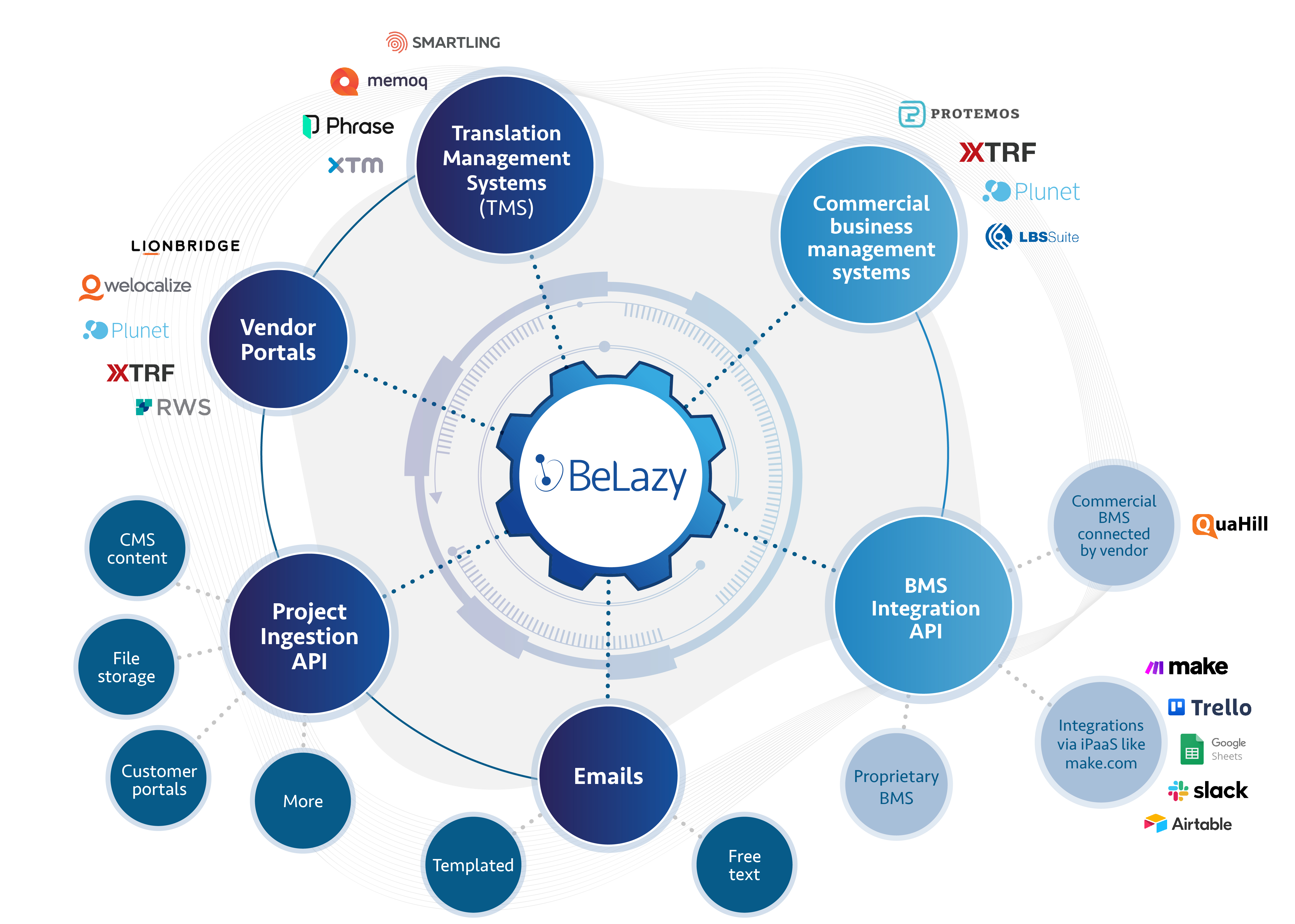
BeLazy is an integration middleware for the translation industry supply chain, seamlessly connecting various sources of work to business management systems (BMS) used by translation companies and enterprises to register, manage, assign and track projects across clients.
Source systems - where the assignments comes from - include:
- vendor portals of commercial business management systems such as customers’ Plunet and XTRF portals, or of large outsources in translation such as the portals of RWS or Welocalize,
- translation management systems (TMS) used by the customers of the organization using BeLazy (e.g. Smartling, GlobalLink, etc.) or used by the organization itself (typically memoQ, Phrase TMS, XTM, Crowdin, etc.),
- the email account(s) of the organization using BeLazy that is used to receive projects from customers, either in templated or free-text emails,
- content management systems (CMS) managing customer websites or other content reuse,
- project management tools used by customers (e.g. Asana, Trello, Workfront),
- any other system that can provide translatable content and metadata, such as languages, task name and deadline.
Note that a translation management system can also act as a destination: BeLazy can create a project in a TMS on behalf of the organization and keep it synchronized with the BMS project throughout its lifecycle.
Business management systems include:
- commercial business management systems supported by BeLazy out of the box, such as XTRF, Plunet or Protemos,
- commercial business management systems integrated by the vendor over the BeLazy APIs, such as Quahill,
- the proprietary business management system of the organization using BeLazy,
- Google Sheets — a fully supported, built-in BMS option available without custom development, suitable for simpler business cases including project registration, management, pricing, and BI reporting,
- other project management tracking systems such as Smartsheet, Trello, or Asana, integrated via the BMS Integration API.
BeLazy is a middleware that uses a mixture of public APIs, captured frontend-backend communication in web applications, and web scraping to give the most user-friendly connection experience. It is a fully extensible system on both sides. This open-ended approach is reflected in the primary API use cases:
-
Project Ingestion (Workspace) API: This API allows you to define and manage any type of source project ensuring seamless integration with your BMS. This API is primarily utilized by users of integrated BMS like Plunet, XTRF, Protemos, Quahill, among others, as it facilitates project creation from non-supported integrations or self-developed customer portals, extending the scope of supported source systems.
-
BMS Integration API: This API bridges the gap between BeLazy and proprietary or non-supported BMS, catering to users with in-house BMS solutions, or BMS lacking extensive API capabilities. BeLazy can integrate with a BMS or the BMS can integrate with BeLazy using the BMS Integration API. This API extends the scope of supported business management systems. The Google Sheets BMS is a ready-made implementation of this pattern — available out of the box with no API development required on the customer side.
-
TMS project creation and sync: BeLazy can create projects in a connected TMS and keep them synchronized with the BMS project. This extends the standard inbound flow with an outbound direction, enabling fully automated end-to-end project lifecycle management across BMS and TMS.
BeLazy also allows you to control which opportunities you want to accept, ensuring that only relevant projects enter your BMS, and offers API calls to interact programmatically with BeLazy’s project management logic.
BeLazy offers a unified REST API that allows developers to extend the scope of systems supported, and control the project management aspects. This documentation, complemented by the API reference, provides a comprehensive guide to integrating with BeLazy.
This documentation provides detailed guidance for translation experts and developers to effectively implement the BeLazy REST APIs and integrate BeLazy with proprietary systems.